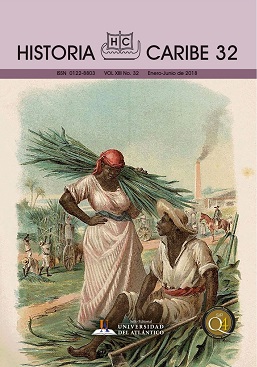
El peso del trabajo esclavo en el ciclo productivo de la campaña de Buenos Aires tardocolonial. Una estimación a partir de un estudio de caso: Los Portugueses (1808-1812)
DOI:
https://doi.org/10.15648/hc.32.2018.2Palabras clave:
Producción, valor, trabajo esclavo, peones.Resumen
El presente artículo tiene por objetivo una caracterización social del fenómeno de la esclavitud para el espacio colonial del Río de la Plata, explicando su forma de inserción dentro del universo de las relaciones sociales de producción. Para ello, observaremos su importancia en el mundo del trabajo, allí donde los esclavos producían mercancías agrarias. El artículo propone un estudio de caso de una estancia colonial: Los Portugueses, ubicada en Chascomús. Allí observaremos la incidencia del trabajo esclavo en el proceso de trabajo y creación de valor, en comparación con el peonaje rioplatense, tomando la totalidad de los días-hombre en la estancia y distinguiendo el “tiempo de trabajo” y el “tiempo de producción”.
Biografía del autor/a
Emilio Fabián Harari, Centro de Estudios e Investigaciones en Ciencias Sociales
Afiliado institucionalmente al Centro de Estudios e Investigaciones en Ciencias Sociales-CEICS (Argentina). Correo electrónico: harari@live.com.ar. El autor es doctor en Historia de la Universidad de Buenos Aires (Argentina). Entre sus publicaciones recientes tenemos: “La población miliciana ante la justicia militar en Buenos Aires (1810-1823). Una comparación entre la ciudad y la campaña", Revista de Indias Vol. 75 No. 264 (2015). Entre sus temas de interés están Revolución burguesa y Formación de los Estados nacionales.
Juan Gabriel Flores, Instituto de Investigaciones en Humanidades y Ciencias Sociales
Cómo citar
Descargas
Publicado
Número
Sección
Licencia
© Universidad del Atlántico. Los originales publicados en las ediciones impresa y electrónica de Historia Caribe, ISSN 0122-8803 e-ISSN 2322-6889, son propiedad de la Universidad del Atlántico, siendo necesario citar la procedencia en cualquier reproducción parcial o total.
Salvo indicación contraria, todos los contenidos de la edición electrónica se distribuyen bajo una licencia de uso y distribución “Creative Commons Reconocimiento-No Comercial 4.0 Internacional” (CC-by-nc). Puede consultarse en https://creativecommons.org/licenses/by-nc/4.0/