Review A Guide to train scientific thinking.
DOI:
https://doi.org/10.15648/cedotic.1.2020.2557Keywords:
EPISTEMOLOGIA, ENTRENAMINETO, PHILOSOPHY OF SCIENCEAbstract
The text starts from an epistemological foundation from the complex thought in that capacity of questioning the reality that the humanbeing has and the ingenuity to decipher the great enigmas of the sciences through the scientific method that starts with the analytical
knowledge developed in the Greek culture until reaching systemic thinking as a holistic condition in its own terms such as breadth,
convergence and interrelations until reaching the option of complex thinking in order to develop the reflection that allows uniting,
contextualizing, globalizing to recognize the integrating subsystems that generate a new reality to explain the phenomena. For,
subsequently, delving into the technical procedures and instruments can be managed from an epistemic coherence, making the investigative
process a totally intellectual work process.
Author Biography
Jairo Eduardo Soto Molina
Doctor en Ciencias Humanas
Coordiando de la maestría en Educación de la Universidad del ATLÁNTICO.
References
Morin, Edgar (1999). El método. El conocimiento del conocimiento. EDITORIAL CÁTEDRA. MADRID, ESPAÑA.
How to Cite
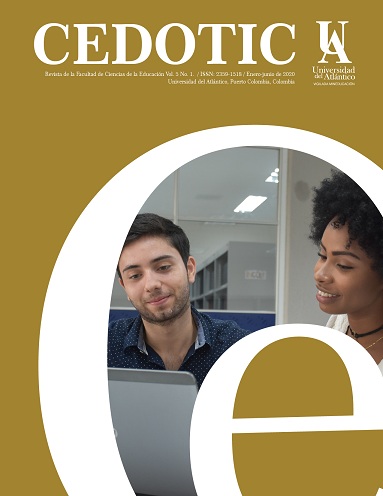
Soto Molina, J. E. (2020). Review A Guide to train scientific thinking. Revista Cedotic, 5(1), 266–268. https://doi.org/10.15648/cedotic.1.2020.2557
Downloads
Download data is not yet available.
Downloads
Additional Files
Published
2020-07-20
Issue
Section
REVIEWS
License
Aquellos autores/as que tengan publicaciones con esta revista, aceptan los términos siguientes:
- Los autores/as conservarán sus derechos de autor y garantizarán a la revista el derecho de primera publicación de su obra, el cuál estará simultáneamente sujeto a la Licencia de reconocimiento de Creative Commons Attribution 4.0 International (CC BY 4.0) que permite a terceros compartir la obra siempre que se indique su autor y su primera publicación esta revista.
- Los autores/as podrán adoptar otros acuerdos de licencia no exclusiva de distribución de la versión de la obra publicada (p. ej.: depositarla en un archivo telemático institucional o publicarla en un volumen monográfico) siempre que se indique la publicación inicial en esta revista.
- Se permite y recomienda a los autores/as difundir su obra a través de Internet (p. ej.: en archivos telemáticos institucionales o en su página web) antes y durante el proceso de envío, lo cual puede producir intercambios interesantes y aumentar las citas de la obra publicada. (Véase El efecto del acceso abierto).