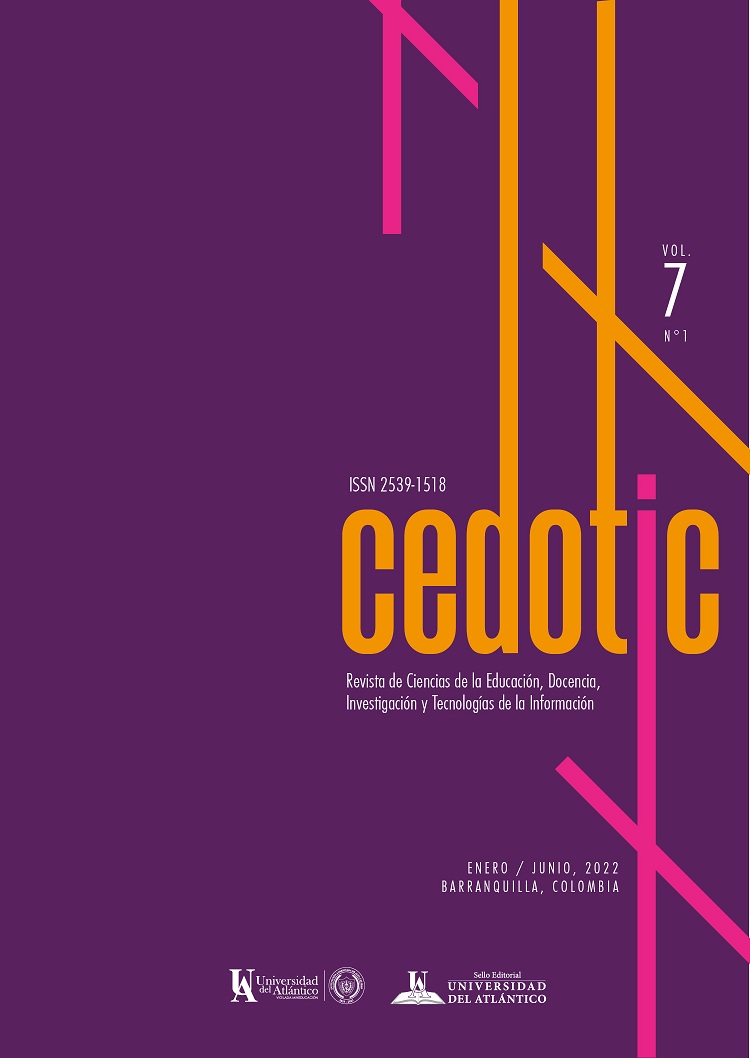
Enseñanza del inglés como lengua extranjera en el aula digital
DOI:
https://doi.org/10.15648/cedotic.1.2022.3253Keywords:
aula digital, teoría fundamentada, clases remotas, aplicaciones digitales, uso de tecnologíasAbstract
This article presents the results of the grounded theory research: "Teaching English as a foreign language in the digital classroom", developed in the Foreign Languages program of the Universidad del Atlántico. It is an article derived from the need to reinvent us during the time of mandatory isolation imposed by the pandemic. It was developed from the second half of 2019 to the second half of 2021. It was about using a text not as the only resource in the classroom, but to complement it with other technologies to implement them in the classroom from a collaborative approach. The purpose was for teachers to make use of Web 2.0 technologies as a pedagogical resource. Thus, stumbles and obstacles of their own or others will be discovered and motivate students in learning English as a foreign language. It was concluded that virtual tools provide a real possibility of learning.
References
Barrios, J. A., & Llinas Torres, J. R. (2018). Identification of influential factors in oral communication competence of the English learning in students. Revista Cedotic, 3(1), 213-227. Recuperado a partir de http://investigaciones.uniatlantico.edu.co/revistas/index.php/CEDOTIC/article/view/2058
Bustos, E. Y., Gómez, N. M. & Galeano, A. A. (2019). El aula virtual como mediación para fortalecer el proceso de enseñanza y aprendizaje de la lengua extranjera inglés en los estudiantes del curso 204 de la IED Gerardo Paredes. Recuperado de: http://hdl.handle.net/20.500.12209/10278
Gil, J. R. H. (2019). Diseño Curricular para la atención educativa de jóvenes con talentos y con Capacidades Excepcionales en Instituciones Inclusivas. Revista Cedotic, 4(1), 41-73.
Glaser, B. G., Strauss, A. L., & Strutzel, E. (1968). The discovery of grounded theory; strategies for qualitative research. Nursing research, 17(4), 364.
Marra, P. P., Norris, D. R., Haig, S. M., Webster, M., Royle, J. A., Crooks, K., & Sanjayan, M. (2006). Migratory connectivity (pp. 157-183).
Soto Molina, Jairo E. (2018). La interculturalidad en la adquisición del inglés: desde la diversidad hacia la equidad; Interculturalism in the acquisition of English: from diversity towards equality. Revista FAIA, 7(31), 8.
Soto Molina, Jairo E. (2019). Las representaciones sociales, pensamiento sistémico y enfoque intercultural de la enseñanza de las lenguas. Entretextos, 13(24), 45-55.
Morse, J. M., Bowers, B. J., Charmaz, K., Corbin, J., Clarke, A. E., & Stern, P. N. (2016). Developing grounded theory: The second generation (Vol. 3). Routledge.
O’Reilly, K., Paper, D., & Marx, S. (2012). Demystifying grounded theory for business research. Organizational Research Methods, 15(2), 247-262.
Sandín Esteban, M. (2003). La enseñanza de la investigación cualitativa. Revista de Enseñanza Universitaria, 21, 37-52.
Pellicano, E., Dinsmore, A., & Charman, T. (2014). What should autism research focus upon? Community views and priorities from the United Kingdom. Autism, 18(7), 756-770.
Soto-Molina, J. E., & Méndez-Rivera, P. (2021). FLIPPED CLASSROOM TO FOSTER INTERCULTURAL COMPETENCE IN ENGLISH LEARNERS. Panorama, 15(29), 32-51.
Sullivan, S. E., & Baruch, Y. (2009). Advances in career theory and research: A critical review and agenda for future exploration. Journal of management, 35(6), 1542-1571.
Stevens, J. P. (2013). Intermediate statistics: A modern approach. Routledge.
Torrance, H. (2011). Qualitative research, science and government: Evidence, criteria, policy and politics.
How to Cite
Downloads
Downloads
Published
Issue
Section
License
Aquellos autores/as que tengan publicaciones con esta revista, aceptan los términos siguientes:
- Los autores/as conservarán sus derechos de autor y garantizarán a la revista el derecho de primera publicación de su obra, el cuál estará simultáneamente sujeto a la Licencia de reconocimiento de Creative Commons Attribution 4.0 International (CC BY 4.0) que permite a terceros compartir la obra siempre que se indique su autor y su primera publicación esta revista.
- Los autores/as podrán adoptar otros acuerdos de licencia no exclusiva de distribución de la versión de la obra publicada (p. ej.: depositarla en un archivo telemático institucional o publicarla en un volumen monográfico) siempre que se indique la publicación inicial en esta revista.
- Se permite y recomienda a los autores/as difundir su obra a través de Internet (p. ej.: en archivos telemáticos institucionales o en su página web) antes y durante el proceso de envío, lo cual puede producir intercambios interesantes y aumentar las citas de la obra publicada. (Véase El efecto del acceso abierto).